DTG vs Screen Printing is a hot topic for brands weighing how best to outfit a merch line, from one-off tees to growing catalogs. Direct-to-garment printing enables vivid color, subtle gradients, and a soft hand that many customers associate with premium feeling fabrics. For teams chasing complex artwork, the ability to reproduce gradients and photo-like imagery without screens is a compelling advantage. Still, the choice depends on scale and speed, because up-front costs and production volumes can flip the economics as volumes grow. In this concise primer, you’ll see where each method shines, how costs stack up, and how to plan a trial run that reveals the best fit for your brand.
In practical terms, designers weigh two pathways for textile decoration: digital inkjet-style methods and traditional stencil-based approaches. The digital route coats fabric with water-based inks that can yield high-resolution images and smooth gradients while preserving a soft feel. The alternative relies on screens and separate color runs to produce bold, durable finishes at scale, with setup costs spreading across larger batches. For brands planning future lines, a screen printing cost comparison against on-demand digital options helps map break-even points, lead times, and consistency across lots. By aligning choice with anticipated order volumes and product goals, you can design a workflow that balances speed, look, and long-term value.
DTG vs Screen Printing: Understanding Each Method
Direct-to-garment printing (DTG) and traditional screen printing are the two foundational approaches for apparel customization. DTG uses inkjet technology to apply water-based inks directly onto the fabric, delivering a soft hand feel and the ability to reproduce intricate, photo-like images with smooth gradients.
Understanding when to use each method helps you optimize image fidelity, fabric type, and production speed. DTG excels with multicolor designs and detailed artwork, while screen printing remains a strong choice for bold, high-visibility prints and long-running runs on a variety of fabrics.
Cost and Setup: When to Invest in DTG vs Screen Printing
When evaluating costs, the decision often hinges on order quantity and setup time. For small batches or highly customized items, DTG minimizes upfront setup because there’s no need to create screens for every color.
In larger runs, screen printing cost comparison reveals economies of scale: per-unit costs drop as volume increases, especially for simple color designs. However, the upfront investment in screens and longer lead times can make DTG less attractive for very large orders.
Design Capabilities for Multicolor Designs and Gradients
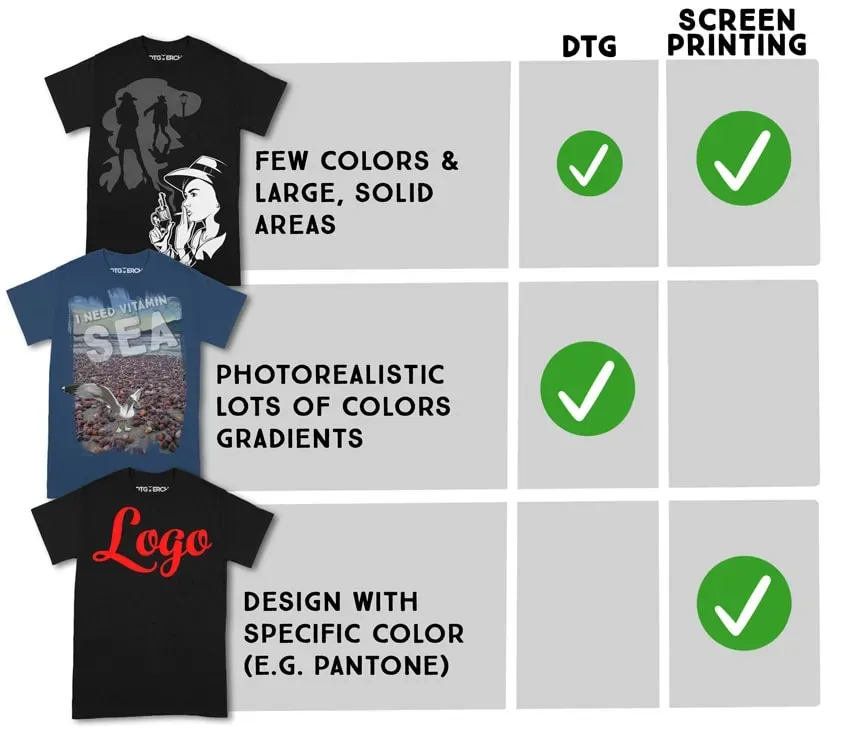
DTG shines with multicolor designs, gradients, and photo-realistic imagery. Its ability to render subtle shading and transition smoothly between hues makes it a preferred method for artwork-heavy lines and designs that demand color fidelity.
Screen printing handles solid color blocks with exceptional vibrancy. While adding more colors increases setup complexity, it remains a reliable option for bold, graphic artwork, especially when paired with halftone techniques to simulate gradients on certain fabrics.
Fabric Feel and Durability: How the Print Feels on Garments
Fabric feel and durability are central to choosing a print method. DTG inks tend to sit softly within the fibers, preserving a comfortable hand on many garment blends and keeping the fabric feel near the original fabric.
Screen-printed inks often sit on the surface, giving prints a slightly thicker feel but excellent long-term durability through washes. The durability can vary with ink chemistry (plastisol versus water-based) and the fabric’s fiber content.
Turnaround Time and Order Size: Planning Production Flow
Turnaround time matters as you move from concept to customer. DTG supports rapid proofs and quick production for small orders, enabling fast iteration when you’re testing designs or offering personalized items.
For larger runs, screen printing can deliver fast batch output once the design is locked and screens are prepared. The method tends to become more cost-efficient with higher volumes, as setup costs are amortized across many units.
Practical Scenarios to Help You Decide Between DTG and Screen Printing
Scenario 1: You’re launching a limited-edition line with complex, multicolor artwork. DTG is typically the better fit, offering high color fidelity, smooth gradients, and fast proofs without creating multiple screens.
Scenario 2: You’re producing hundreds to thousands of shirts with a simple color palette and strong color punch. Screen printing often delivers the best cost-per-unit and durability for long-running designs, especially when order quantity and setup time considerations favor batch production.
Frequently Asked Questions
DTG vs Screen Printing: When should I choose direct-to-garment printing over screen printing for a first batch of custom shirts?
DTG vs Screen Printing is ideal for small batches or highly detailed artwork. Direct-to-garment printing (DTG) offers excellent color fidelity and a soft hand, making it great for multicolor designs or photos. Screen printing delivers bold colors and durability but requires multiple screens for color-heavy art and is typically more cost-efficient at larger volumes. For a first batch with intricate art, DTG often provides faster proofs and flexible customization, while screen printing becomes more economical as you scale.
DTG vs Screen Printing: How does the screen printing cost comparison look for small runs with complex, multicolor designs?
For small runs, DTG can be more cost-effective because there’s minimal setup per design and no per-color screens. Screen printing incurs higher upfront costs for screens, but the per-unit price drops with quantity, especially for simple two- to three-color designs. If you’re testing many variants or want quick iterations, DTG’s flexibility helps; for a predictable large run of a simple design, screen printing often wins on cost per unit.
DTG vs Screen Printing: Which method handles multicolor designs and gradients best for premium artwork?
DTG excels at multicolor designs and gradients due to full-color inkjet capabilities and smooth transitions. Screen printing can still deliver bold solids, but adding colors increases screens and setup. For artwork-heavy or photo-like designs, DTG is typically preferred; for bold, simple color blocks, screen printing can be more efficient.
DTG vs Screen Printing: How do fabric feel and durability compare across different fabrics?
DTG generally yields a softer fabric feel because inks are absorbed into the fibers, especially on blends. Screen-printed inks sit on the surface and can feel slightly thicker but are often very durable across wash cycles. The fabric type, ink chemistry (water-based DTG vs plastisol screen inks), and garment color all influence feel and longevity.
DTG vs Screen Printing: How do order quantity and setup time influence the choice for a merch line?
DTG shines with small to moderate orders and when you want to avoid color-separation setup. Screen printing becomes more cost-efficient as order quantity grows, especially for designs with few colors. Consider your design’s color count and run size to balance upfront setup against per-unit costs and production speed.
DTG vs Screen Printing: Which provides faster proofs and turnaround for small batch testing, considering direct-to-garment printing advantages?
DTG typically offers faster proofs and quicker turnarounds for small batches because there’s little to no setup per design. Screen printing can take longer upfront due to screens and color separations, but once set, large runs print quickly. For rapid prototyping and frequent updates, DTG is usually the better choice.
| Aspect | DTG (Direct-to-Garment) Highlights | Screen Printing Highlights |
|---|---|---|
| Overview | DTG uses inkjet printers to apply water-based inks directly to fabric, yielding a soft hand feel, excellent color fidelity, and the ability to reproduce complex, photo-like images. It’s especially popular for small batches or highly detailed artwork. | Screen printing uses a mesh stencil (screen) to transfer ink. Each color needs a separate screen; known for bold colors, durability, and cost efficiency at larger quantities. Best for simple designs with few colors and predictable print runs. |
| Cost & Setup | No setup per color; you pay for ink and maintenance. Flexible for testing multiple designs or one-off orders. | Upfront cost for producing screens for each color; per-unit cost drops with volume, making it economical for large runs; small orders can be costlier due to setup. |
| Design Capabilities | Excels at many colors, gradients, and photo-realistic detail; well-suited for artwork-heavy designs and per-item customization. | Strong for solid blocks of color with high vibrancy; more colors require more screens; can use halftone and gradients but with more setup. |
| Fabric Feel & Durability | Prints have a soft feel, ink penetrates fibers well, good on high-thread-count blends. | Inks sit on the surface and can feel thicker; highly durable over many washes; longer-lasting for heavy-wear items. |
| Turnaround & Order Size | Rapid proofs and quick production for small orders and personalizations. | Longer setup times, but very fast production for large runs; efficient per unit cost for stock designs. |
| Environmental & Material Considerations | Ink chemistry matters; water-based DTG inks offer soft hand and often lower odor; care with fabric choice affects results. | Ink and curing impact environmental considerations; garment color, fabric, and care affect outcomes. |
| Practical Decision Guide | – Small-to-moderate orders with color detail: consider DTG for color fidelity with minimal setup. – Complex or photos: DTG handles gradients; favors customization. |
– Large runs with simple colors: screen printing often offers lower per-unit cost and durability. – Stable designs: favorable for screen printing once set up. |
Summary
Conclusion: DTG vs Screen Printing is a decision that depends on your goals, order sizes, and design needs. Both methods offer distinct advantages: DTG is strong for intricate, multicolor artwork and quick iterations on small batches, delivering a soft hand and high color fidelity. Screen printing excels in large-scale runs, bold color punch, and cost efficiency as volume grows, especially for simple color designs. By weighing cost and setup, color capability, fabric feel, durability, and order quantity, you can choose the method that best aligns with your brand, your designs, and your customers’ expectations.